

DAL is the only company in the world that uses IIR and FIR analog speaker controllers
- The large board is populated with 41 high quality components
- On the large board you find part of a 4th order filter for the low driver - the other parts of the 4th order filter of this low path are on the smaller board.
- And on the large board there is further a Hi Driver RMS limiter protection, a 4th order filter for the high driver consisting of (i) the high path itself and a first EQstage to adjust the high path slope, (ii) second EQ-, (iii) third EQ-, (iv) fourth EQ-stages to linearise the frequency and phase response of the high driver to be in +/- 2,5dB and (v) a fith EQ stage over the voltage divider to recover high frequncy loss above 10KHz which is naturally caused by the use of a Constand-Q horn.

▪ Only such efforts in each product will guaranty that GAE compact point source speaker systems are working "self contained" linear up to very high sound pressure levels without any further Signal processing. To get something like "Safety" against "stupid operation" you can simply add an electronic high pass to protect the cone tranducer against extrem excursion and if you want add a peak limiter adjusted to guaranty double of RMS power for the loudspeaker.
▪ If you now look to passive frequency dividing networks of the competition you will see -let me say 4,5 or 6 components, but not 41 (!) The competition simply applies a watsever crossover function and let the DSP do the rest. So you can't operate the loudspeaker itself without the proprietary AMP.
▪ Our tradition is to supply a loudspeaker "self containt working" with an excellent sound. Additional DSP from our side will correct only cosmeticly in terms of sound, but will sipply different functionality -not possible with passive components, as there are (i) floor monitor baffle step correction, (ii) point source array processing, (iii) prot

 Advantage:
- Quiet stage(makes new friends in monitor world)
- Less excitation of reverberant field
- Easier horizontal arraying
- Much less off-axis noise immissio
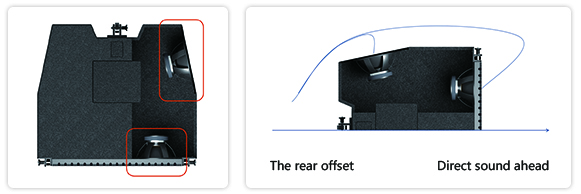


Test data center has its own tweeter driver with phase plug FEM and BEM modeling to optimize its coupling with different dispersion speakers.
- DAL is one of the very few manufacturers who has own engineering for cone transducers and High driver, horns and waveguides, which are then exclusively manufactured for DAL.
- We supply very few components "from catalogues". Also we invented important things like Twin Coaxial loading or the integration of LIR filters for cardioid dispersion which was adopted by others later. Also we do our own FEM and BEM simulations for e.g. Phase plugs in Hi drivers to be optimised coupled to horns with differnet dispersion. You can see the difference if you remove a front grill and compare the horn throats. As a very simpl example we are the only ones who has a top quality quarter wave low frequency horn system on the market which is designed from the own simulations and not a copy of third party ideas.

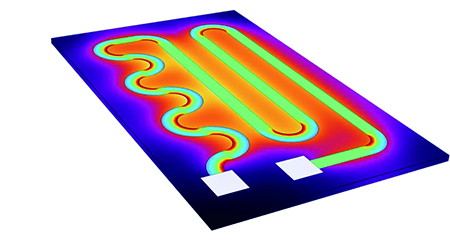
CURRENT
- Resistors and conductive devices can be effectively analyzed by simulating various forms of current, such as DC, transient or AC. Under static and low frequency conditions, when the magnetic field can be ignored, current modeling is enough to obtain accurate results, and it is very efficient to calculate potential based on Ohm's Law. According to the generated potential field, many physical quantities can be calculated: resistance, conductivity, electric field, current density and power loss.
- With the "AC/DC module", you can run steady-state, frequency-domain and time-domain analysis, as well as small signal analysis. You can also analyze capacitance effects in the time and frequency domains.

 MAGNETOSTATICS
- For the most common case where current and magnetic material exist, the vector field formula can define the potential and input current, and calculate the current density distribution, magnetic field, magnetic force, power consumption and mutual inductance.
- Calculate static magnetic field, parasitic inductance and forces on coil, conductor and magnet. You can choose from a large material database containing a variety of nonlinear magnetic materials, or you can define your own nonlinear materials. Depending on the presence of current and/or magnetic material, you can use many different formulas to calculate.
- In the absence of current, both finite element method and boundary element method are suitable for solving magnetostatic problems. What’s more, you can also combine them into hybrid finite element-boundary element method.

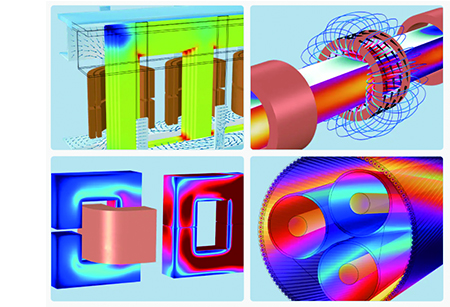 ELECTROMAGNETIC FIELD
- When simulating cables, wires, coils, solenoids and other inductive devices, magnetic fields are generated by current flowing through conductive materials. For time-varying fields with significant induction effect, there is bidirectional coupling between electric field and magnetic field. In these cases, the skin depth is often the same as the device size, but the wavelength is much larger, so the vector field formula is needed.
- Frequency domain, small signal analysis and time domain modeling are supported in 2D and 3D. This module provides a special formula, which is especially suitable for time domain magnetic modeling of materials with strong nonlinear E-J characteristics (such as superconductors).

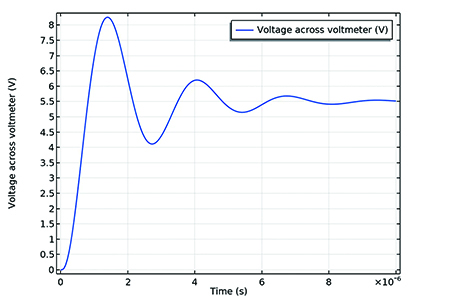 CIRCUIT
Create lumped systems to simulate currents and voltages in circuits, including voltage and current sources, resistors, capacitors, inductors, and semiconductor devices. The circuit model can also be connected to two-dimensional and three-dimensional distributed field models. In addition, the circuit topology can be exported and imported in SPICE net table format.

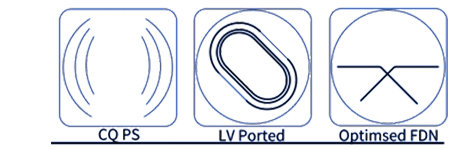 THE MEANING OF THE SOUND SYSTEM ICON
- CQPS: Constant-Q Point Source is with a horn system design which grants a linear behaviour of frequency response outside the main axis. In detail this means that all frequencies linear slope down to -6dB if you rotate the system.
- LV-Ported: Low Velocity Ported: I am using two different design preferences for ported systems. For compact cabinets for fullrange systems my design of the port arrangements include the best compromise between: -minimum port noise, -minimum turbulences, - high effeciency.
- Optimised FDN: Meaning is that the passive frequency diving network is not only an "X-over". It includes networks to compensate resonances of the driver itself, is equalising the frequency response, is compensating high early hignfrequency roll off and has a passive RMS limiter on board protecting the high driver (against crazy DJ's). All this without any external electronic help.